
Preprocessor in C
0 1343
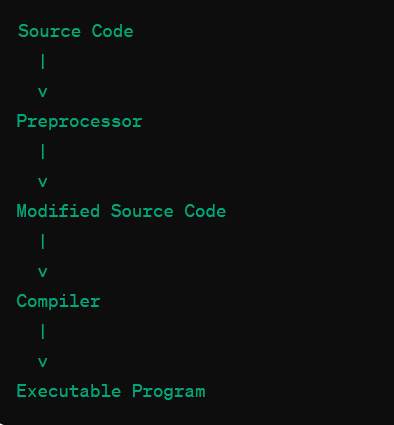
The preprocessor in C is a tool that processes the source code before actual compilation.
It handles directives that start with a # symbol, like #include, #define, and #ifdef.
These directives allow for file inclusion, macro definition, and conditional compilation.
Preprocessor Directives in C
#include: Includes a header file into the source code. #define: Defines a macro or constant. #ifdef / #ifndef: Checks if a macro is defined or not. #if / #elif / #else / #endif: Conditional compilation based on expressions. #undef: Undefines a macro. #pragma: Provides compiler-specific directives. #error: Generates a compile-time error message.Macros
Macros are used to define constants or small snippets of code that can be expanded inline. Example:#define PI 3.14159 #define SQUARE(x) ((x) * (x))
File Inclusion
File inclusion directives are used to include header files in the source code. Example:#include<stdio.h>#include "myheader.h"
Conditional Compilation
Conditional compilation directives allow parts of the code to be compiled or omitted based on certain conditions. Example:#ifdef DEBUG
// Debugging code
#endif
Other Directives
This category includes other directives like #undef, #pragma, #error, and #line, which provide additional functionalities like undefining macros, compiler-specific directives, generating error messages, and changing line numbers. Example:#undef PI #pragma warning(disable: 4996) #error "An error occurred!" #line 100 "new_file.c"These main types of preprocessor directives enable C programmers to write more flexible, modular, and maintainable code by allowing conditional compilation, code reuse through macros, and seamless integration of header files. Example:
// program for preprocessor in C #include<stdio.h>Output:// Define a macro for maximum value #define MAX(a, b) ((a) > (b) ? (a) : (b)) // Conditional compilation #ifdef DEBUG #define DEBUG_MSG "Debugging is enabled." #else #define DEBUG_MSG "Debugging is disabled." #endif int main() { int x = 10, y = 20; // Print the maximum of x and y using the MAX macro printf("Max of %d and %d is: %d\n", x, y, MAX(x, y)); // Print the debug message printf("%s\n", DEBUG_MSG); return 0; }
Maximum of 10 and 20 is: 20
Debugging is disabled.

Share:








Comments
Waiting for your comments