C Tokens in C Language
0 1703
In C language C tokens are
the Smallest Units of a Program.
They are categorized into different types.
1 Keywords in C
2
Identifiers in C
3 Constants in C
4 String Literals in C
5 Operators in C
6 Punctuation Symbols in C
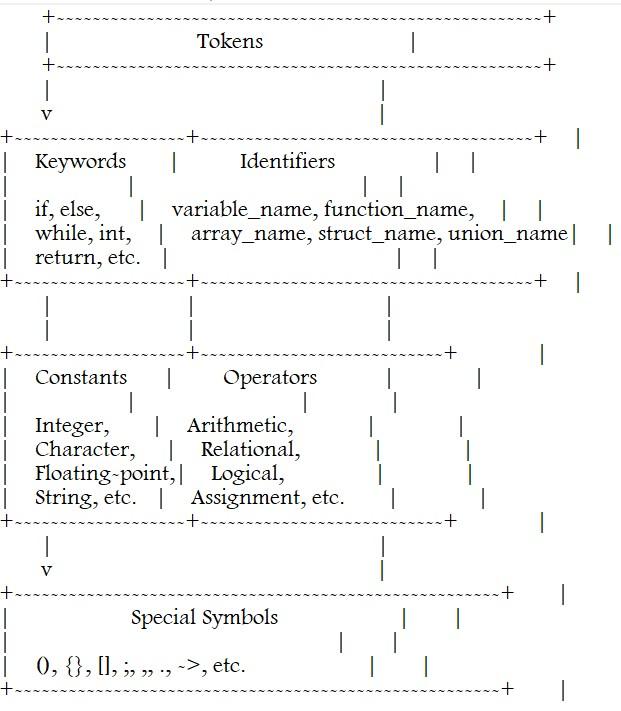
Different types of Tokens in C
Keywords in C
keywords like main, return are reserved words with predefined meanings. For example:int main(){
return 0;
}
Identifiers in C
Identifiers such as int, char, float are names given to various program elements. For example:int age=45;
Constants in C
Constants are Fixed values used in the program. For example:const float pi=3.14;
String Literals in C
String Literals are Sequence of characters closed in double-quotes. For example:char *greeting = "good morning world";*greeting points to the location where the string 'good morning world' is stored in memory.
Operators in C
Operators are Symbols used to perform different operations. For example:int total=12+3;
Punctuation Symbols in C
Punctuation Symbols are Characters used for Syntax and Structure. operators like +, -, *, /, =, ==, !=, <, >, <=, >=, &&, ||, etc., are essential punctuation symbols in C. For example:if(condition){
printf("True")
} Each tokens have a specific purpose and they contribute to the structure and functionality of the C program.
C Program for C tokens
#include<stdio.h>Output:int main() { int n = 23; int m = 67; int sum = n + m; if(sum > 10) { printf("sum is greater than 10\n"); } else { printf("sum is not greater than 10\n"); } for(int i = 0; i < 5; i++) { printf("Iteration %d\n", i); } printf("The sum is : %d", sum); return 0; }
sum is greater than 10
Iteration 0
Iteration 1
Iteration 2
Iteration 3
Iteration 4
The sum is: 90

Share:


Comments
Waiting for your comments