
VR Hand Tracking
0 1170
VR Hand Tracking: The Future of Controller-Free Interaction
VR Hand Tracking has become one of the most exciting upgrades in immersive tech. Instead of holding bulky controllers, users can now move their hands naturally and interact with virtual objects just like in the real world. This shift is redefining gaming, productivity, training simulations, and accessibility tools.ðŸ–ï¸ What Exactly Is VR Hand Tracking?
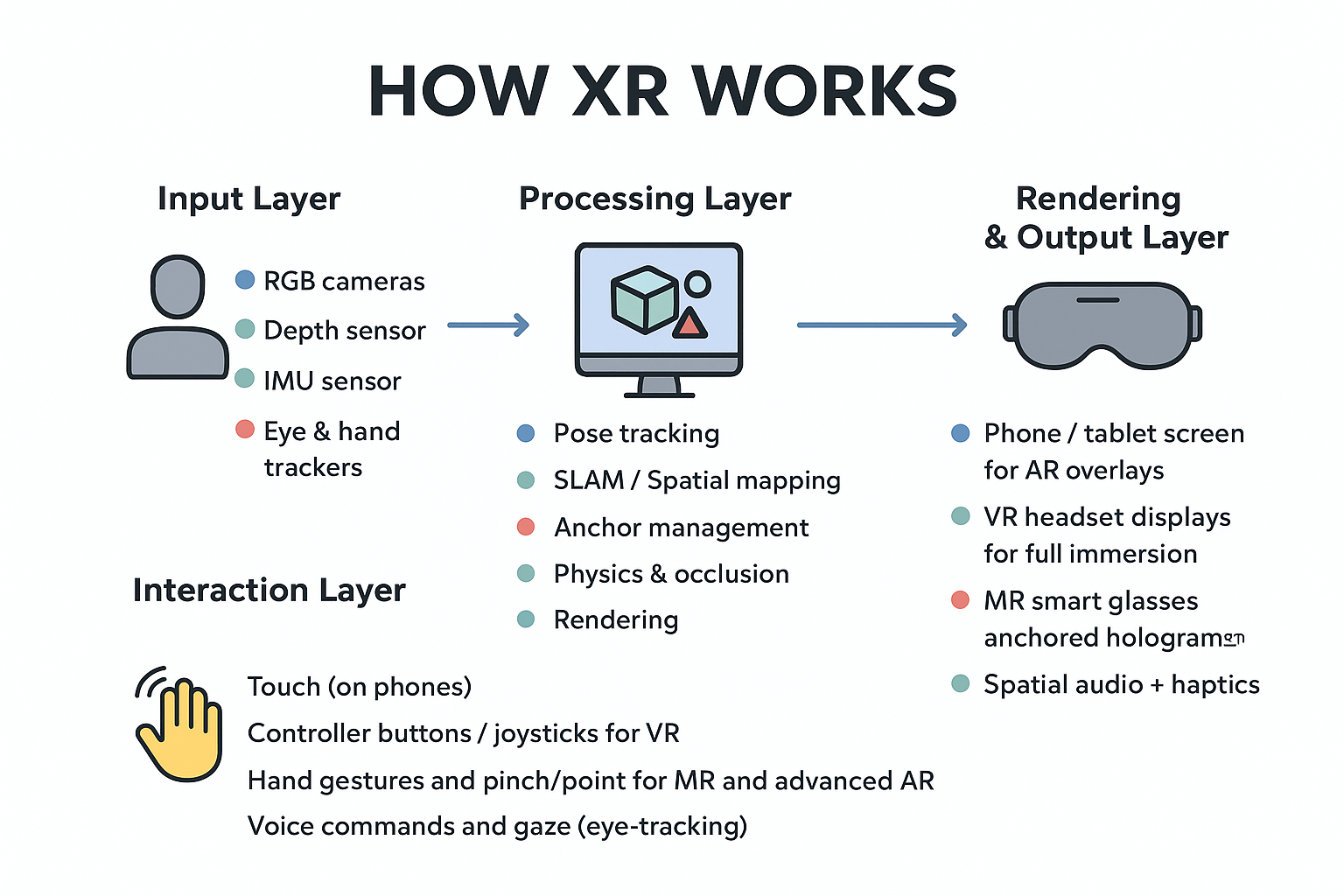
In simple terms, VR Hand Tracking is a technology that lets your headset detect the position, shape, and motion of your hands. Using advanced sensors, depth cameras, and AI-based gesture recognition, it maps your physical movements into the virtual environment in real time.âš™ï¸ How Hand Tracking Works Behind the Scenes
Although it feels magical, a lot happens in the background. The system captures your hand shape, identifies finger positions, and calculates motion paths. Then, AI models translate this data into meaningful gestures like grabbing, pointing, pinching, rotating, or swiping inside VR.Example: Basic Hand Tracking Workflow
// Pseudocode representation of VR hand tracking flow
function TrackHands() {
    const handData = captureHandFrame();
    const gesture = interpretGesture(handData);

    if(gesture === "pinch") {
        selectObject();
    } else if(gesture === "grab") {
        holdObject();
    }
}
🎮 Hand Tracking in Gaming & Entertainment
Hand-tracking-enabled games feel far more natural. Instead of pressing buttons, players physically swing swords, solve puzzles using gestures, or create art by simply moving their hands. This controller-free experience delivers smoother and more intuitive gameplay.ðŸ‹ï¸â€â™‚ï¸ How It Enhances Training & Professional Workflows
Industries like healthcare, education, architecture, and defense are using hand tracking for interactive training. Surgeons can practice procedures, workers can learn machinery operation, and designers can shape 3D models without needing external devices.Example: Gesture for 3D Object Rotation
if (gesture == "two_hand_rotate") {
    model.rotate(xAxis, yAxis);
}
🧠Why AI Is Essential in VR Hand Tracking
AI models analyze hand positions, detect gestures, and adjust accuracy even when lighting changes or fingers briefly overlap. Continuous learning improves tracking precision and reduces lag, which is crucial for a believable interaction experience.🚀 Challenges That Researchers Are Solving
Hand tracking still has limitations. Fast gestures can be missed, complex finger motions may not register perfectly, and accuracy drops in low-light environments. Developers are working on better sensors, smarter machine-learning models, and optimized depth tracking.🌠Why VR Hand Tracking Is the Future
As VR transitions towards more natural and immersive interaction, hand tracking will become a standard feature. The future includes hybrid gesture-voice control, touch-simulation haptics, and ultra-accurate AI tracking. A world where your hands are the only controller is not far away.✨ Final Thoughts
VR Hand Tracking is more than a convenience — it's a major step toward making virtual worlds feel alive. Whether it's gaming, training, creativity, or workplace tools, this technology is shaping the next era of XR interaction.If you’re passionate about building a successful blogging website, check out this helpful guide at Coding Tag – How to Start a Successful Blog. It offers practical steps and expert tips to kickstart your blogging journey!
For dedicated UPSC exam preparation, we highly recommend visiting www.iasmania.com. It offers well-structured resources, current affairs, and subject-wise notes tailored specifically for aspirants. Start your journey today!

Share:



Comments
Waiting for your comments