
Marker vs Markerless AR
0 1191
ðŸ”✨ Understanding Marker vs Markerless AR
Augmented Reality (AR) has two major tracking systems that drive most industry applications — Marker AR and Markerless AR. While both enable digital content to appear in the real world, the methods they use to track surfaces, objects, and user environments are quite different. In this blog, we break down Marker vs Markerless AR in a simple, practical, and fresh way so you can choose the right approach for your next AR experience.🎯 What is Marker-Based AR?
Marker-based AR uses predefined visual patterns (like QR codes, images, logos, or distinct shapes) to trigger and anchor digital content. When the camera detects the marker, the AR system calculates its position, orientation, and scale — then overlays the virtual object in the correct place.- Requires a specific printed marker
- Highly stable tracking
- Predictable placement
- Great for controlled indoor environments
🌠What is Markerless AR?
Markerless AR doesn’t depend on any specific print or image. Instead, it uses environment understanding through real-time mapping and sensors. This is powered by SLAM (Simultaneous Localization and Mapping).- No need for QR codes or predefined markers
- Tracks surfaces like floors, walls, and tables
- Allows walking around 3D objects naturally
- Perfect for dynamic or outdoor environments
// Detecting a plane and placing a 3D model
override fun onTapPlane(hit: HitResult, plane: Plane, event: MotionEvent) {
    val anchor = hit.createAnchor()
    val node = AnchorNode(anchor).apply {
        setParent(arSceneView.scene)
    }

    val modelNode = TransformableNode(arFragment.transformationSystem).apply {
        renderable = myModel
        setParent(node)
    }
}
🆚 Key Differences: Marker vs Markerless AR
While both aim to deliver immersive AR, their applications vary widely. Here’s a clean comparison:| Factor | Marker AR | Markerless AR |
| Tracking Requirement | Printed marker required | Surface/environment scanning |
| Accuracy | Very stable when marker is clear | Depends on lighting & sensors |
| Ideal Use Cases | Education, product demos, packaging | Gaming, navigation, furniture placement |
| Cost | Cheaper and simpler | Higher development complexity |
🧪 Where to Use Marker-Based AR?
Marker AR shines when the environment is controlled and the experience requires stability. Industries often use it for:- Interactive textbook AR experiences
- In-store product packaging demos
- Museum exhibits with AR labels
- Business cards with scannable 3D animations
🚀 Where to Use Markerless AR?
Markerless AR feels more natural because it blends digital objects with real surroundings without needing a specific marker. Ideal applications include:- AR gaming with spatial movement
- Interior design and furniture visualization
- AR navigation in malls, airports, and cities
- Fitness training overlays & motion guidance
🤖 Tech Behind Markerless AR: SLAM, Depth & AI
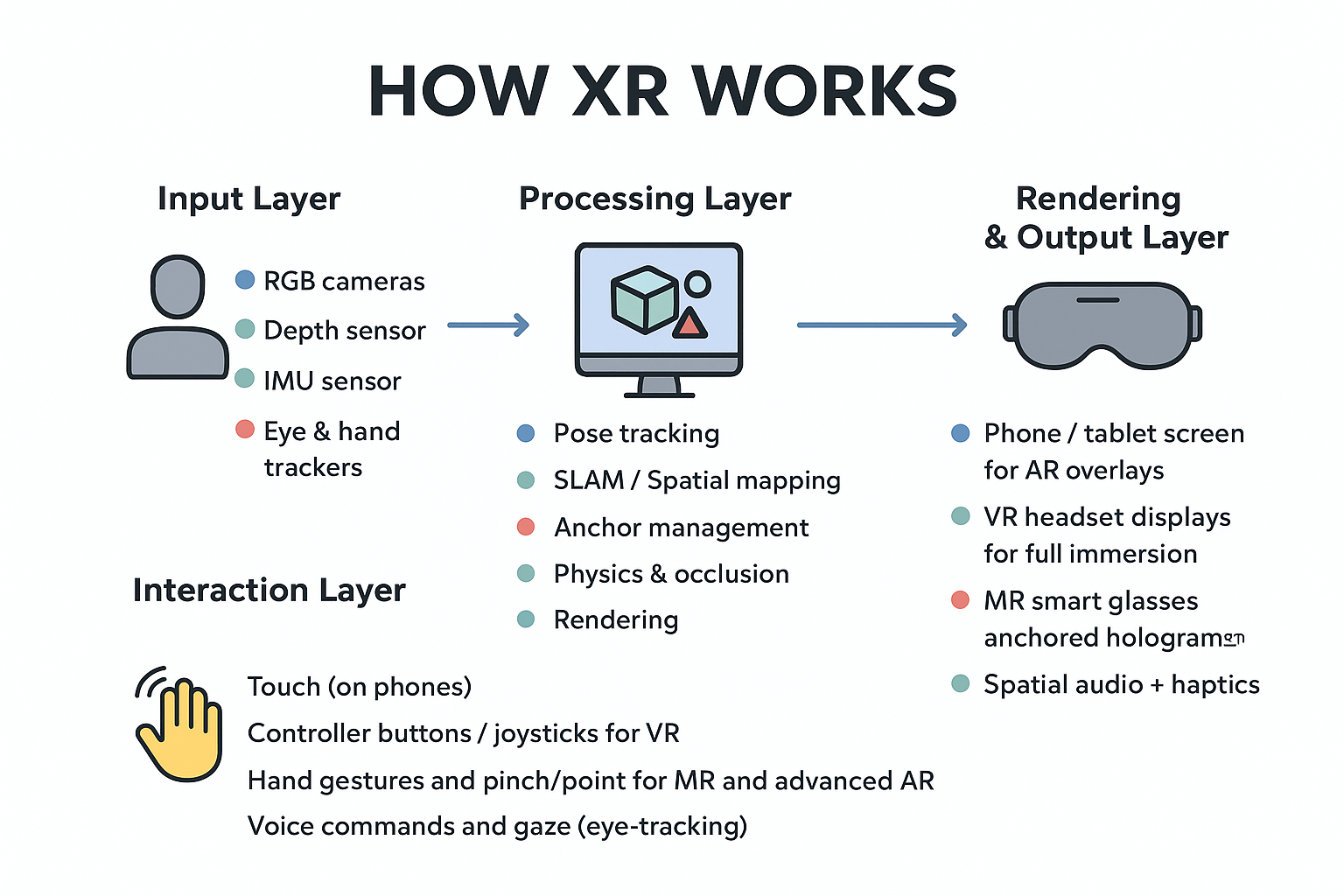
Markerless AR relies heavily on SLAM, which combines computer vision with sensor fusion. It identifies surfaces, depth, edges, and even semantic objects like chairs or tables. Machine learning adds intelligence, enabling apps to react based on real-world context. Simple pseudo-code for plane detection logic:
// Pseudo-code logic for SLAM-based plane detection
if (camera.detectsSurface()) {
    plane = environment.mapSurface()
    placeObject(plane.position)
}
📌 Final Thoughts on Marker vs Markerless AR
When comparing Marker vs Markerless AR, the best choice depends on your project. If you want stability, predictable activation, and cost-effective development — choose Marker AR. If your app requires immersive movement, real-world depth, and flexible placement — go for Markerless AR. Both technologies are powerful in their own way, and as hardware evolves, the line between them will continue to blur, making AR more accessible, intuitive, and immersive.If you’re passionate about building a successful blogging website, check out this helpful guide at Coding Tag – How to Start a Successful Blog. It offers practical steps and expert tips to kickstart your blogging journey!
For dedicated UPSC exam preparation, we highly recommend visiting www.iasmania.com. It offers well-structured resources, current affairs, and subject-wise notes tailored specifically for aspirants. Start your journey today!

Share:



Comments
Waiting for your comments