
jQuery Events
0 2758
- To make a page dynamic and responsive, we need to perform some actions on the HTML DOM elements.
- These actions are called events.
- Although JavaScript has several built-in ways of reacting to user interaction and other events, jQuery enhances and extends the basic event handling mechanisms to give them a more elegant syntax and making them more powerful.
- Some examples of events are listed below:
- A mouse click
- Form submission
- Loading a web page
- Web page scrolling
- Pressing a key on the keyboard
- Mouse hover on an element
Related Topics:
jQuery Syntax
jQuery Selectors
jQuery Events
Some most useful HTML DOM events are listed below: 1 Mouse events:- click
- dblclick
- mouseenter
- mouseleave 2 keyboard events:
- keyup
- keydown
- keypress 3 form events:
- submit
- change
- blur
- focus 4 Document/Window Events:
- load
- unload
- scroll
- resize
$("button").click();
The next step defines what should happen when the event fires. You must pass a function to the event.$("button").click(function(){
// action goes here!!
});
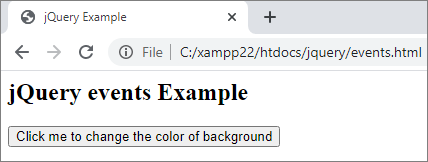
Example:<html>Output:
<head>
<title>jQuery Example</title>
<script type = "text/javascript"
src="https://ajax.googleapis.com/ajax/libs/jquery/3.5.1/jquery.min.js">
</script>
<script>
$(document).ready(function(){
$(".bt").click(function(){
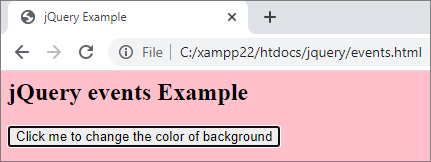
$("body").css("background","pink");
});
});
</script>
</head>
<body>
<h2>jQuery events Example</h2>
<button class="bt">Click me to change the color of background</button>
</body>
</html>
 After, click on the button,

Share:


Comments
Waiting for your comments